 Gelato
 Smart Wallets, Gas Sponsorship And Rollup Infrastructure
Gelato provides programmable wallet services and managed rollup infrastructure, including transaction relaying and tools for sponsoring blockchain fees. Its wallet components connect account permissions with transaction delivery and flexible gas payment. Gas Tank supplies a shared service balance across supported networks. Rollup services operate infrastructure beneath applications, including sequencers and remote procedure call (RPC) access. Earlier automation products handled scheduled contract execution and off-chain computation, which are separate functions from wallet signing and gas sponsorship.
Smart Accounts, Relayers and Rollup Services
Smart accounts control permitted actions, transaction services submit those actions and rollup infrastructure operates the chain that processes them. Account abstraction means that an account can use programmable rules for authorizing calls. A relayer handles transaction submission on behalf of an integration. In an ERC-4337 flow, a bundler submits user operations through an EntryPoint contract, while a paymaster can cover their gas costs.
These components address different parts of an application. Changing account permissions affects what a wallet can authorize. Sponsoring fees affects who pays for execution. Running a rollup changes the execution environment itself. A project can integrate wallet infrastructure on an existing supported chain without also commissioning a custom blockchain.
How Do Smart Accounts and Gas Sponsorship Work Together?
Smart accounts authorize programmable actions, while gas sponsorship supplies payment for eligible execution under the application's funding and policy conditions.
Account Logic and Delegation
EIP-7702 lets an externally owned account, or EOA, authorize delegation to smart contract code while retaining its address. The delegated implementation determines the available account behavior. Batching and restricted permissions require account logic that implements them; the standard does not install those features automatically. Authorization therefore concerns both the chosen implementation and the actions that its code permits. A delegation authorization can change an account's execution behavior beyond the immediate transaction. Delegated code runs in the account's context, so the authorization must identify the intended implementation.
Bundlers and Paymasters
ERC-4337 uses a UserOperation, a structured request that describes an account action. A bundler packages valid operations into a transaction for the EntryPoint contract. A paymaster agrees to fund eligible operations, subject to validation. The account's authorization rules remain necessary even when another party covers gas. A sponsorship policy grants fee coverage, not blanket permission to spend wallet assets.
Gelato supports ERC-4337 and EIP-7702 integrations. Their compatibility still requires the selected account implementation, execution route and network to support the intended operation.
Gas Tank Funding and Policy Controls
Gas Tank is Gelato's payment system for sponsored execution and applicable service charges. Its funded balance can cover sponsored calls across supported networks. Mainnet funding uses USDC and depositing also requires native tokens for the deposit transaction's gas. A pending deposit becomes usable after it reaches the required confirmations and the service credits the balance.
Sponsorship policies can limit spending globally or per user, restrict eligibility through allowlists and blocklists or define time-bound campaigns. Post-execution billing uses actual gas consumption, with service charges added under the applicable terms. Token-payment configurations collect fees from the user in an accepted ERC-20 token, while sponsorship charges the application's funded service balance.
Rollup Deployment, Settlement and Data Availability
Gelato's Rollup-as-a-Service supports configurable blockchain deployments with managed sequencers, RPC endpoints and monitoring for the selected stack.
Sequencing and RPC Services
A sequencer orders transactions and produces rollup blocks. RPC endpoints expose the interfaces that applications use to read chain state and submit transactions. Managed operations include monitoring, availability measures and upgrades. These services support the running chain; application contracts still define their own permissions and business rules. An operational sequencer cannot correct an unsafe authorization rule inside an application's contract.
Framework choices include Arbitrum, OP Stack and Polygon-based options. The platform also presents based and zero-knowledge rollup offerings, whose sequencing and verification arrangements require their own configuration.
Settlement and Data Availability
A settlement layer anchors the rollup's state commitments and the applicable verification or dispute process. Data availability concerns access to the information needed to reconstruct and check chain state. These choices affect the chain's security assumptions. Using a managed sequencer does not give every deployment the same settlement guarantees, withdrawal behavior or data availability design. Optimistic and zero-knowledge designs use different mechanisms for establishing valid state transitions. Their bridge rules and verification arrangements also differ. Selecting a framework therefore involves the chain's operating architecture as well as application compatibility.
Turbo Sequencing and Chain Performance
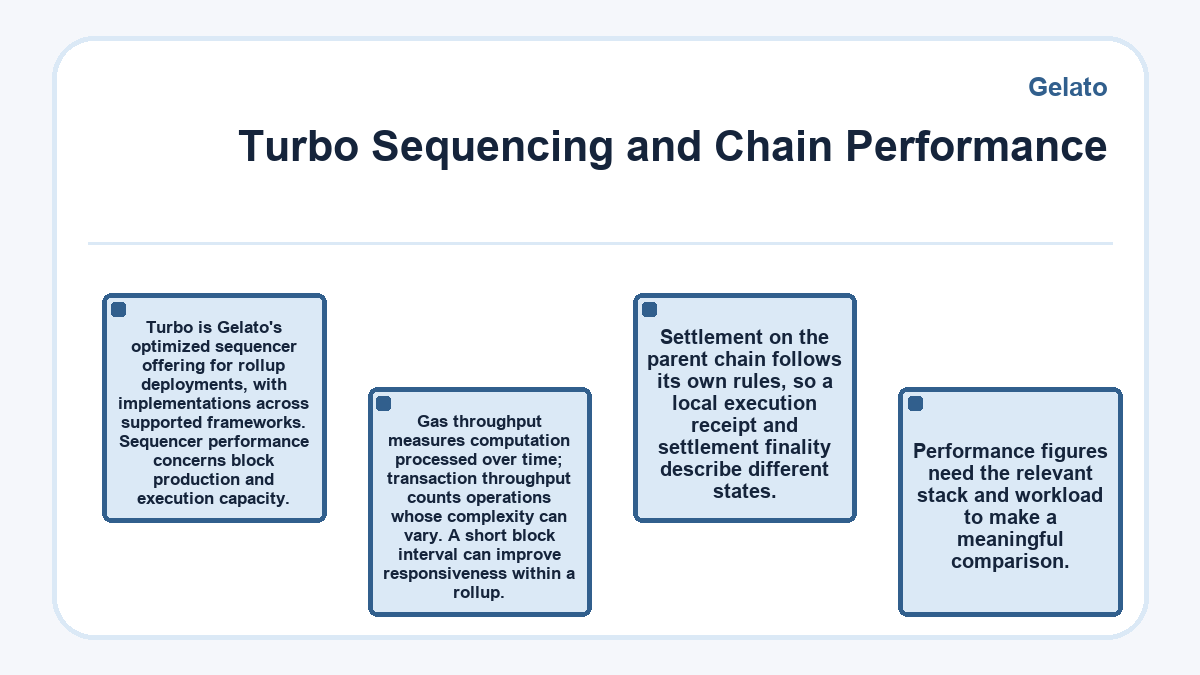
Turbo is Gelato's optimized sequencer offering for rollup deployments, with implementations across supported frameworks. Sequencer performance concerns block production and execution capacity. Gas throughput measures computation processed over time; transaction throughput counts operations whose complexity can vary. A short block interval can improve responsiveness within a rollup. Settlement on the parent chain follows its own rules, so a local execution receipt and settlement finality describe different states. Performance figures need the relevant stack and workload to make a meaningful comparison.
Embedded Wallets and Account Access
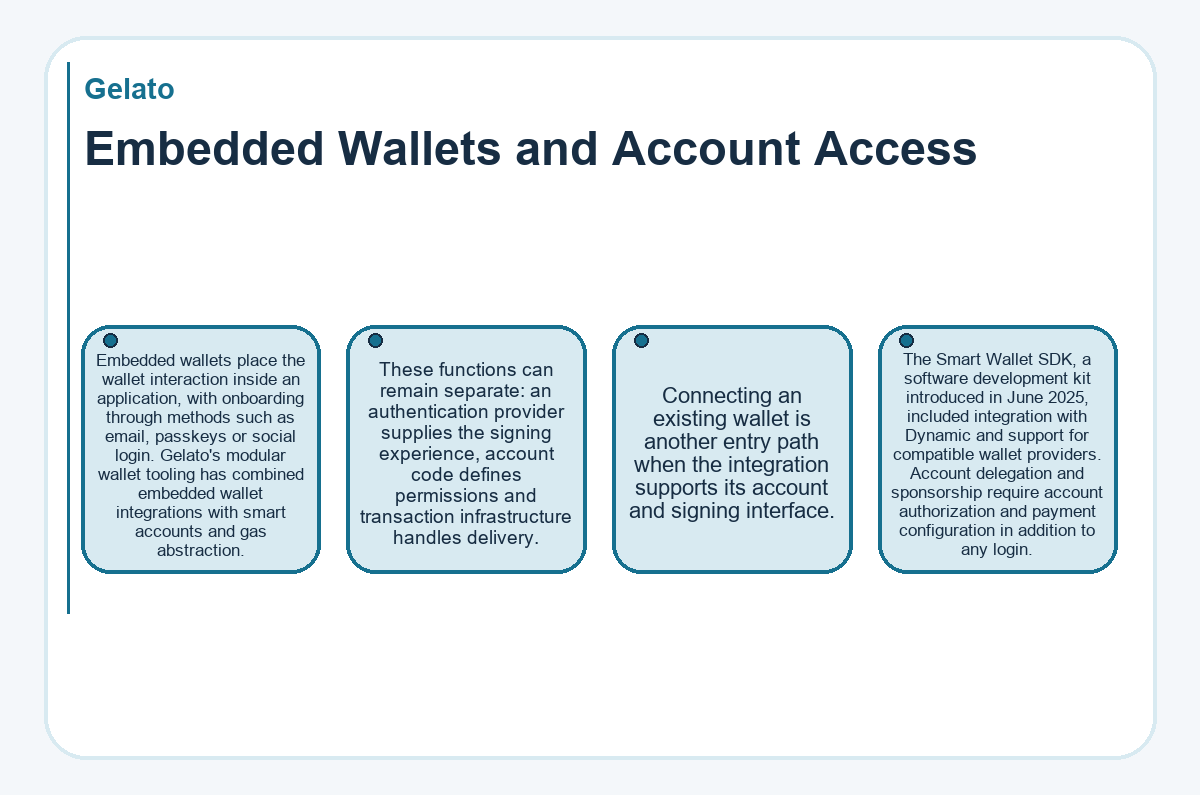
Embedded wallets place the wallet interaction inside an application, with onboarding through methods such as email, passkeys or social login. Gelato's modular wallet tooling has combined embedded wallet integrations with smart accounts and gas abstraction. These functions can remain separate: an authentication provider supplies the signing experience, account code defines permissions and transaction infrastructure handles delivery. Connecting an existing wallet is another entry path when the integration supports its account and signing interface. The Smart Wallet SDK, a software development kit introduced in June 2025, included integration with Dynamic and support for compatible wallet providers.
Account delegation and sponsorship require account authorization and payment configuration in addition to any login.
Automation Roots and GEL Governance
Gelato's earlier automation infrastructure executed contract calls when configured time, event or condition triggers made them eligible. Web3 Functions extended that model with off-chain computation and access to external APIs. Solidity Functions handled conditions available on-chain, while TypeScript Functions could obtain external data and prepare contract calls. Gelato's automation and Web3 Functions service is deprecated; replacing a transaction relayer does not also replace an application's scheduling and condition-checking backend. Gelato VRF used the distributed randomness beacon drand to supply random values for smart contracts. That mechanism served a different purpose from fetching market data or relaying a user-authorized call.
Gelato announced GEL in May 2021 for proposed token-holder voting through the Gelato DAO. Its original model proposed executor staking and slashing alongside governance over protocol rules, including executor fees.
Which Integration Changes Matter for Legacy Relay Code?
Legacy Relay integrations need attention to both deprecated SDKs and retiring contract patterns, including trusted forwarders and SyncFee.
Archived SDKs
The old Smart Wallet and Relay SDK repositories were archived on February 13, 2026.
The legacy Relay SDK is deprecated in favor of the gasless SDK.
The replacement package is @gelatocloud/gasless. Its integration choices include direct Turbo Relayer access, a smart account client and an ERC-4337 bundler client.
Trusted Forwarders
Gelato's ERC-2771 migration requires applications continuing that meta-transaction design to deploy their own trusted forwarder. The provided legacy forwarder is being retired without a replacement from Gelato. This change concerns the supplied contract infrastructure; it does not remove ERC-2771 as a standard or prohibit an application from maintaining its own compatible implementation.
SyncFee and Contract Payments
The SyncFee migration retires the old callWithSyncFee method and GelatoRelayContext pattern. Continuing to collect fees from users requires custom token-collection logic alongside sponsored submission. A package upgrade alone does not recreate fee handling that an old target contract expected the relay context to supply.
Choosing Wallet Services or a Custom Chain
Wallet services handle programmable account actions and gas payment on supported chains. A custom rollup supplies a configurable execution environment that can also use compatible wallet services. The useful choice follows from the account behavior and infrastructure that the application needs.
- Choose sponsorship when the application will fund eligible gas costs and maintain its Gas Tank balance.
- Use programmable account logic when permitted actions need batching or restricted signing permissions.
- Keep an existing ERC-4337 account when compatible bundler support meets the integration's requirements.
- Plan a rollup when the application requires configurable chain infrastructure and ongoing chain operations.
- Include contract migration when an integration depends on the retiring forwarder or SyncFee patterns.
Gas sponsorship remains subject to call eligibility and available funding. A deployment's chain configuration also determines which wallet and execution integrations it can support.
Managed Infrastructure and Direct Operation
Managed infrastructure moves transaction delivery or chain operations into a service relationship with API access, billing and operating dependencies. Gelato provides those infrastructure functions while an application's contracts retain their own rules. The current gasless SDK also allows different integration depths, so adopting a relayer does not require rebuilding every part of a wallet application.
Operating comparable components directly means maintaining the submission service, RPC connections or sequencer infrastructure that the chosen design needs. Managed services reduce that operating work in exchange for service dependencies and charges. An application that only needs different account behavior or gas payment can retain an existing supported chain; a custom rollup adds a separate chain to operate.
Gelato FAQs
Does Sponsoring a Transaction Also Fund Its Transfer Amount?
Gas sponsorship covers execution fees, while the value transferred by a wallet or contract requires its own funding. A sponsored smart account call still needs the assets that its action spends. The sponsor's Gas Tank balance is a service-payment balance, not the account's transferable asset balance.
Can a Gas Tank Deposit Be Made From a Smart Contract Wallet?
Cross-chain USDC deposits into Gas Tank through Circle's Cross-Chain Transfer Protocol (CCTP) do not support deposits from Safe or other smart contract wallets. That restriction concerns the deposit mechanism. Smart accounts can still use sponsored transactions. An externally owned account can fund the team's Gas Tank through that route.
What Does the Submitted Status Mean in the Gasless SDK?
Submitted means that the relayer has submitted the transaction to the network, while successful inclusion remains a separate state. An asynchronous request identifier lets the application track the operation. Receipt handling or a success notification supplies the execution result; the identifier alone does not establish successful contract execution.
How Does a Relayer Rejection Differ From an Onchain Revert?
A rejection happens at the relayer, while a revert means that execution failed on-chain. The gasless SDK reports these as separate states. That difference changes the diagnostic focus: a rejected request needs examination of submission or validation conditions, while a revert calls for examination of the contract execution failure.
Is an Email Login Enough to Establish Wallet Custody?
An email login describes authentication, while custody depends on the wallet's key-management and signing design. Embedded wallet implementations can use different storage, recovery and authorization arrangements. The ability to sign, export credentials or recover access follows from the selected provider and configuration, not the wording of the login button.
Are Gasless Transactions Automatically Private?
Gasless transactions do not automatically hide blockchain activity. Sponsorship changes how execution fees are paid. On a public EVM chain, submitted transactions still expose their public addresses and transaction data under that chain's normal rules. Any confidentiality mechanism needs a separate implementation; paying through Gas Tank does not supply one.
Where Can a Gas Tank Balance Be Withdrawn If Account sign-in Fails?
Gelato's Gas Tank withdrawal page permits access by connecting the linked wallet without account sign-in, so a failed application login does not remove that wallet-based access path for withdrawal when the linked wallet remains available and the balance belongs to it.
Will a rollup's Fast Block Time Shorten Its Canonical Withdrawal Delay?
A fast block interval does not determine the canonical bridge's withdrawal delay. On an optimistic rollup, settlement and withdrawal can require the applicable challenge process to finish. Other designs use their own proof and bridge conditions. Sequencer responsiveness therefore cannot supply a universal withdrawal completion time.
updated